Grandparent Scam: How to Protect Elderly Family
Grandparent scams cost victims over $5M in 2025 alone. Learn how AI voice cloning supercharges this fraud and how to protect elderly loved ones now.
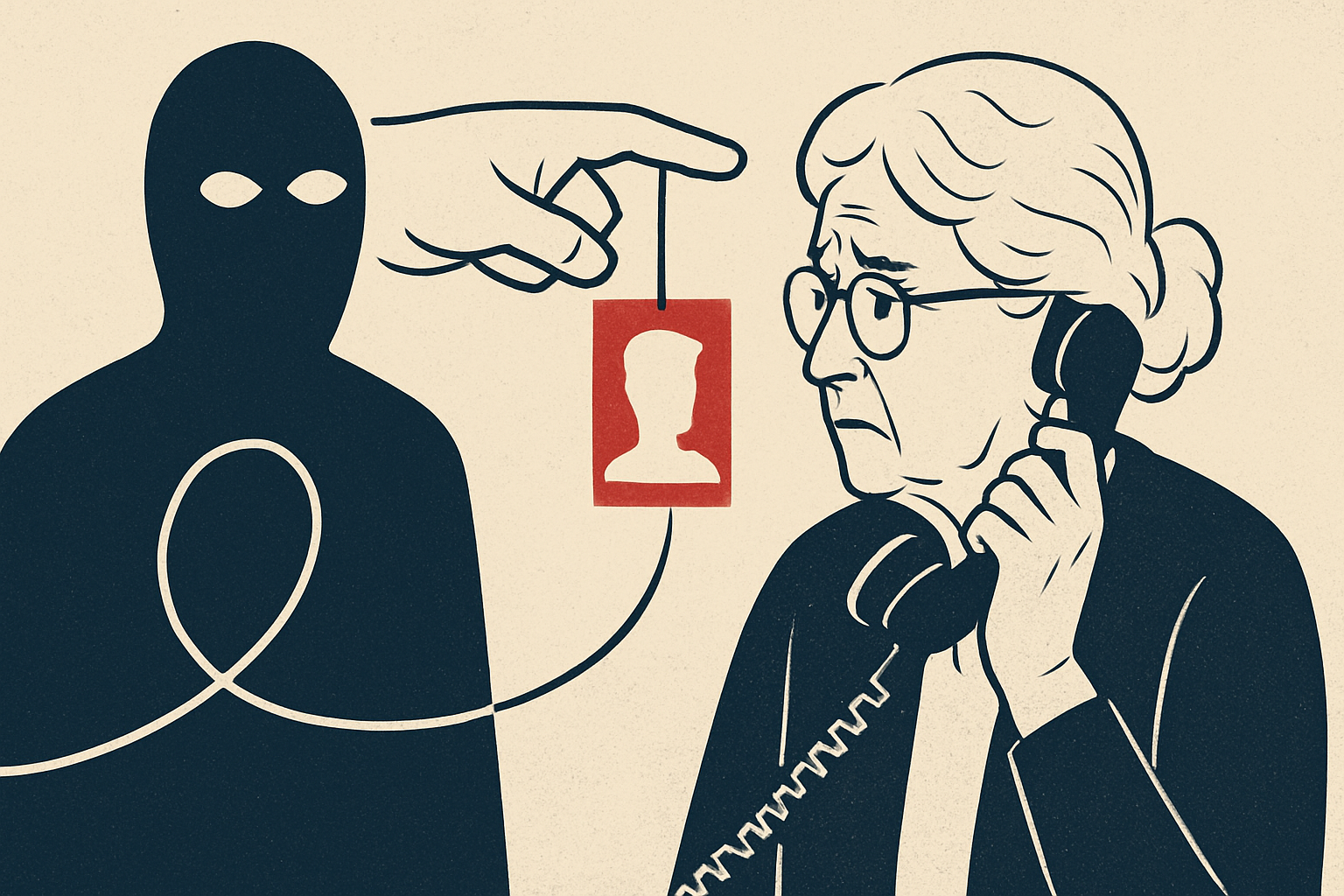
Imagine your phone rings. On the other end, a trembling voice — unmistakably your grandchild's — says they've been in a car accident, are sitting in a jail cell, and need bail money wired immediately. They beg you not to tell anyone. Your heart races. You reach for your wallet. That moment of panic is exactly what fraudsters engineer — and in 2025, it cost American seniors over $5 million in confirmed losses from distress and grandparent scams alone [1]. The true toll is almost certainly far higher, since the FBI's own Internet Crime Complaint Center acknowledges that reported losses represent only a fraction of what was actually stolen [1].
What Is the Grandparent Scam and How Does It Work?
The grandparent scam — officially categorized by the FBI as a 'distress scam' — is a form of impersonation fraud designed to exploit an older adult's love for and instinctive protectiveness of their family [2]. The mechanics follow a predictable but devastatingly effective script. A caller contacts an elderly person, either posing directly as a panicked grandchild or first tricking the target into volunteering the grandchild's name by asking an open-ended question like, 'Hi Grandma, do you know who this is?' Once the grandparent supplies the name, the scammer adopts the persona seamlessly. The fabricated crisis typically involves a car accident, an arrest, a medical emergency, or trouble in a foreign country — situations that demand immediate financial help and, critically, secrecy [4]. A second caller often joins the con, impersonating a lawyer, bail bondsman, or law enforcement officer to lend institutional credibility to the demand [3]. Payment is almost always requested in cash, wire transfer, cryptocurrency, or gift cards — methods that are irreversible and nearly impossible to trace [4]. In one landmark 2025 prosecution, 25 Canadians were charged with running coordinated call centers that defrauded hundreds of elderly Americans out of more than $21 million using exactly this playbook [3].
AI Voice Cloning: The Dangerous New Weapon
What has transformed the grandparent scam from a frightening nuisance into a near-perfect crime is artificial intelligence. Criminals are now using AI voice-cloning tools to synthesize a grandchild's actual voice from as little as a few seconds of publicly available audio — a social media video, a voicemail greeting, or a podcast appearance [1]. The resulting clone is convincing enough to fool even close family members in real time. In 2025, the FBI's IC3 received more than 3,100 complaints from seniors specifically referencing AI, with losses exceeding $352 million across AI-assisted elder fraud categories [1]. Voice cloning made grandparent scams 'nearly undetectable by ear,' according to a 2025 senior fraud review, and AI-generated phishing messages eliminated the telltale grammar mistakes that once helped seniors identify fakes [1][2]. The FBI's 2025 IC3 Annual Report marked the first time in the center's 25-year history that it devoted a dedicated section to artificial intelligence as a cybercrime tool — a milestone that underscores how rapidly this threat has escalated [1].
“Voice cloning can also be used to request wire payment in so-called 'grandparent' or 'distress' scams, in which voice cloning technology is used to mimic the sound of a loved one in distress.” — HousingWire, reporting on FBI IC3 2025 Internet Crime Report
Why Seniors Are Disproportionately Targeted
Elder fraud is not random. Criminals specifically profile and select older adults for several structural reasons. Seniors are perceived — often correctly — to have accumulated retirement savings and home equity. Social isolation is a major vulnerability: many elderly adults live alone or at a distance from family, making it harder for them to pause, consult someone they trust, and fact-check a distress call before acting [4]. Older individuals also tend to exhibit greater deference toward authority figures, making them more susceptible to a 'lawyer' or 'officer' on the line reinforcing urgency. The scale of the resulting harm is staggering: in 2025, adults age 60 and older filed more than 201,000 scam complaints with the FBI's IC3, with reported losses exceeding $7.7 billion — a 59% increase in losses and a 37% increase in victim count compared to 2024 [1]. The FTC, meanwhile, estimated that real losses to fraud among older adults in 2024 may have reached $81.5 billion once unreported cases are factored in [2].
Warning Signs to Watch For
Recognizing the red flags of a grandparent scam in real time is the most powerful defense any family can deploy. The FDIC and security researchers consistently identify the following danger signals: (1) Extreme urgency — the caller insists money must be sent before a court date, deadline, or release window, creating pressure that overrides rational thinking [4]; (2) A demand for secrecy — the 'grandchild' or accompanying 'officer' instructs the grandparent not to tell other family members, which is a manipulation technique designed to prevent verification [2][4]; (3) Unusual payment methods — requests for gift cards, wire transfers, cryptocurrency, or a courier arriving at the door to pick up cash in person, as occurred in the Canadian call-center prosecution [3]; (4) Inconsistencies in the voice or story — even AI clones can slip, and a grandchild who 'sounds a little different' or can't answer basic family verification questions is a serious warning sign; (5) Unsolicited contact — the call comes out of nowhere, with no prior indication the grandchild was traveling, in legal trouble, or in any distress [4]. The FTC has documented that urgency and fear are the fastest-growing scammer tools for overriding the good judgment of older adults [2].
How to Protect Your Elderly Family Members
Protection begins with open, non-judgmental conversation before any scam attempt occurs. Fraud awareness experts consistently recommend these proactive steps: Establish a family code word — agree on a private word or phrase that only genuine family members know, and instruct elderly relatives to demand its use before acting on any distress call. This single step defeats even an AI voice clone. Audit social media exposure — if grandchildren post videos, vacation photos, or voice content publicly, that material can be harvested to build a clone or craft a convincing cover story. The FDIC specifically advises against posting names, birthdays, and daily activities of relatives on social media [4]. Create a verification protocol — if a panicked call arrives, hang up and call the grandchild back directly on a number already stored in your phone, or call a parent or sibling. Never use a callback number provided by the caller. Designate a trusted contact — many banks and brokerage firms now allow account holders to list a trusted contact person who can be notified if suspicious transactions are flagged. Set up this protection proactively. Slow the transaction down — wire transfers, gift card purchases, and cryptocurrency kiosk deposits are the hallmarks of fraud. Banks and credit unions are increasingly trained to ask questions when elderly customers make large, unusual transactions [4]. Scammers move extremely quickly to extract and move funds, often overseas, making recovery nearly impossible after the fact [2].
“It can be really difficult to recover the money. The scammers move really quickly to get the money … and move it elsewhere, often overseas.” — Kathleen Daffan, Assistant Director, FTC Bureau of Consumer Protection, via CNBC
What to Do If You or a Loved One Is Targeted
If you suspect a grandparent scam is underway — or has already succeeded — act on multiple fronts immediately. First, do not send money, and if a courier is already en route, do not open the door. Contact local law enforcement right away. Second, report the incident to the FBI's Internet Crime Complaint Center at ic3.gov and to the FTC at reportfraud.ftc.gov — every report contributes to investigations like the one that brought down the Canadian call-center network [3]. Third, older victims age 60 and above can call the National Elder Fraud Hotline, a free resource from the U.S. Department of Justice, at 1-833-FRAUD-11. Fourth, notify your bank or financial institution immediately if any funds were transferred; while recovery is difficult, early notification gives the institution the best chance to recall or freeze the transaction. Finally, do not be ashamed. The FBI has long noted that elder fraud is dramatically underreported because victims feel embarrassed or believe nothing can be done [1]. Reporting is not just about recovering your money — it is how law enforcement builds the case files that lead to arrests, prosecutions, and the dismantling of the criminal networks behind these scams [3].
- 01FBI: Seniors lost $7.75B to cybercrime in 2025 — a 59% jump— HousingWire / FBI IC3 2025 Report
- 02FBI reports $352 million in AI scam losses targeting adults over 60— Fox News / FBI IC3
- 03Canadians' 'grandparent scam' cost Americans $21 million— NPR
- 04Scams Targeting Older Adults— FDIC