Investment Fraud on Social Media: How to Stay Safe
Investment fraud on social media cost Americans $1.1 billion in 2025 alone. Learn how these scams work, the warning signs, and how to protect yourself.
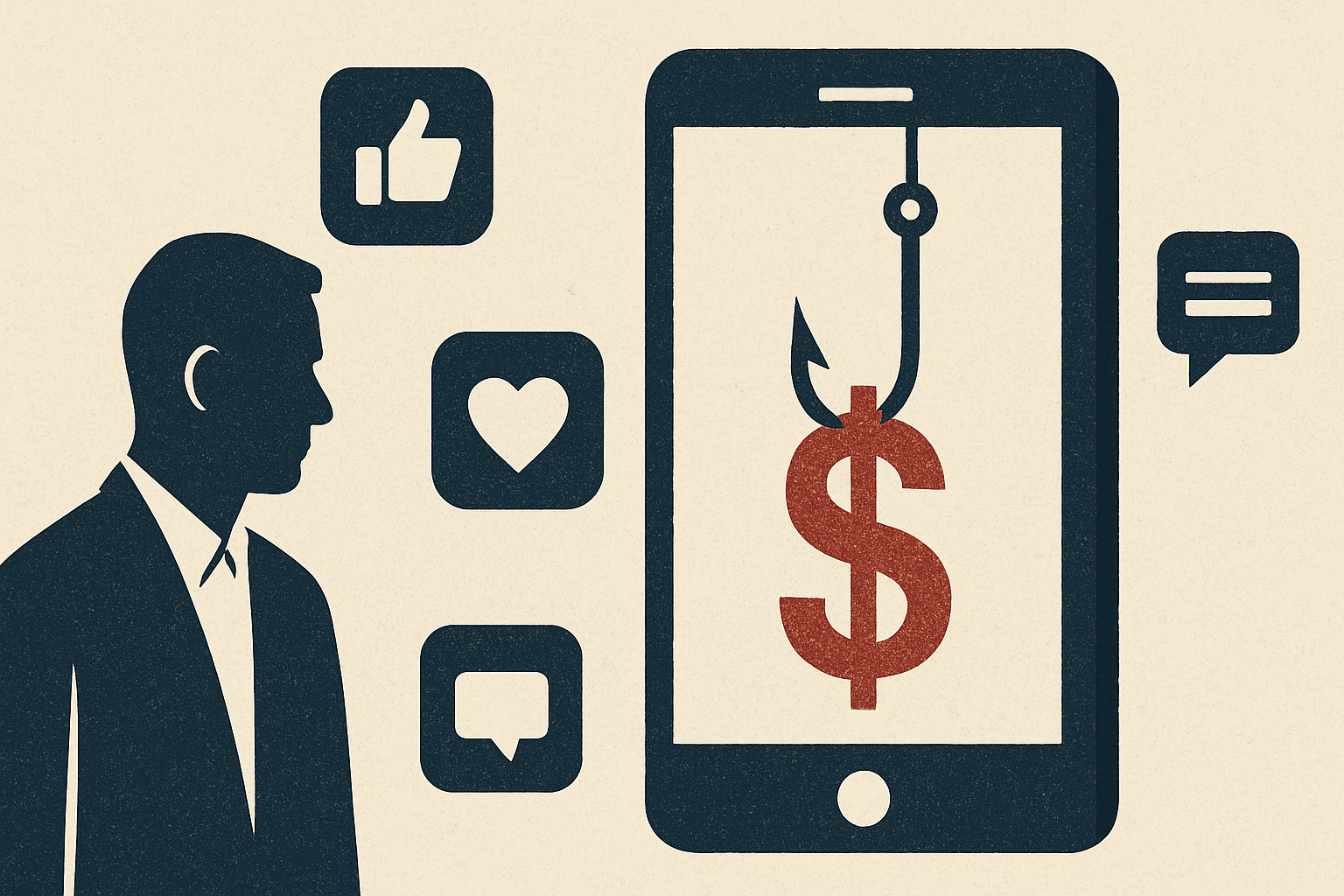
Social media has become the single most dangerous gateway for investment fraud in America. In 2025, nearly 30% of all fraud victims reported that the scam started on a social platform — and investment scams led that category by a wide margin, with reported losses of $1.1 billion, more than half of all money lost to social media scams combined [1]. Meanwhile, the FBI's Internet Crime Complaint Center documented investment fraud as the primary financial driver of cybercrime, accounting for nearly 49% of all scam-related losses in its 2025 report [4]. The threat is escalating rapidly, and understanding how these schemes operate is the first line of defense.
What Is Social Media Investment Fraud and How It Works
Social media investment fraud is an umbrella term for schemes in which criminals use platforms like Instagram, Facebook, TikTok, WhatsApp, and Telegram to lure victims into fake or manipulated investment opportunities. The scams take several distinct forms, but they share a common playbook: establish contact, build trust, introduce an 'opportunity,' and then vanish with the victim's money.
The most prevalent variant is the 'pig butchering' or relationship investment scam, where a stranger — often posing as a successful professional — initiates contact through a direct message or 'accidental' text, builds a relationship over weeks, then casually introduces a cryptocurrency trading platform. Victims are shown fabricated profits and encouraged to invest increasingly larger sums. When they try to withdraw, they are hit with fake 'tax fees' or 'unlock charges' before the scammer disappears entirely [1][3].
A second major threat flagged by the FBI is the 'ramp-and-dump' stock manipulation scheme, a modern evolution of the classic pump-and-dump. Fraudsters promote fake 'investment clubs' via social media ads and then funnel members into secure messaging apps. The organizers secretly hold large positions in low-priced stocks and coordinate club members to buy in, artificially inflating the price. Once the price peaks, the criminals sell their shares at a profit, leaving club members holding worthless stock [2]. So far in 2025, the FBI documented at least a 300% increase in victim complaints referencing this specific fraud compared to 2024 [2].
A third common format involves ads or posts promising access to exclusive investing programs or 'proven' strategies. These scams often started with an ad or post offering a program to teach victims how to invest, or they created WhatsApp groups full of 'successful investors' sharing fake testimonials [1].
“The scheme, known as a 'ramp-and-dump' stock manipulation, targets US investors through online engagement, often via social media advertisements or messages promoting an 'investment club' of fellow investors, some of which may be bots or fake accounts.” — FBI Public Service Announcement, July 3, 2025
The Scale of the Problem: By the Numbers
The financial damage from investment fraud is staggering and growing. Consumers reported losing $5.7 billion to investment scams in 2024 — more than any other fraud category — representing a 24% increase over 2023 [3]. By 2025, FTC figures identified investment scams as the top loss category at $7.9 billion [4]. Among victims who specifically reported investment-related scams to the FTC, 79% said they lost money, with a median individual loss exceeding $9,000 per case [3].
The social media channel is accelerating these losses at an alarming rate. Reported losses to social media scams have increased eightfold since 2020, making it far more costly than any other contact method used by scammers [1]. Consumers of all ages report social media as the most common method of contact for investment scams specifically [3]. The FBI also notes that almost 83% of all financial losses reported to the IC3 in 2024 were cyber-enabled and often initiated through social media or email [3].
Warning Signs to Watch For
Recognizing a social media investment scam before money changes hands requires knowing what the red flags look like in practice:
**Unsolicited contact with a financial pitch.** Whether it arrives as a DM, a 'wrong number' text with a follow-up, or a social media ad promising extraordinary returns, legitimate investment opportunities do not find you through cold outreach on Instagram or Telegram [2].
**Impersonation of credible figures.** Fraudsters routinely pose as licensed financial advisors, well-known wealth managers, or representatives of real brokerage firms to create an air of legitimacy [2]. Always verify credentials independently through FINRA BrokerCheck or the SEC's Investment Adviser Public Disclosure database before engaging.
**Pressure to act quickly.** High-pressure urgency — a 'limited window,' a 'company breakthrough,' or a 'government approval' about to move the market — is a hallmark of ramp-and-dump and other social media investment scams. Legitimate investments do not evaporate overnight [2].
**Requests to move conversations off-platform.** The IC3 warns that once initial contact is made, it is common for scammers to ask to move messaging to another platform, typically an encrypted app where there is less oversight and fewer records [3].
**Fake testimonials and fabricated account dashboards.** Investment club members sharing apparent profit screenshots, or a platform showing impressive returns in a victim's account, are almost always fabricated. Victims who attempt to withdraw funds are typically told they owe fees or taxes first — a final extraction before the scammer cuts contact [1].
**Low-priced or obscure stocks with 'guaranteed' returns.** Urgent pitches to purchase penny stocks in new or emerging companies, paired with promises of dramatic price increases or guarantees to cover losses, are defining characteristics of ramp-and-dump schemes [2].
Who Is Being Targeted
While fraud awareness campaigns have historically focused on older adults, social media investment fraud cuts across age groups with unusual breadth. The FTC found that people in their 20s are losing money to fraud at a higher rate than those in their 70s, a trend driven significantly by social media exposure [3]. At the same time, older adults reported losing far more money to investment scams than to any other fraud type in 2024, and they frequently reported being targeted via social media [3]. The FBI's ramp-and-dump data show victim reports remain fairly consistent among all age groups above 30, confirming this is not a scam that discriminates by generation. Anyone active on social media with any level of investment interest is a potential target.
How to Protect Yourself
The FTC, FBI, and IC3 offer consistent, actionable guidance for anyone using social media:
**Never let someone you met only on social media direct your investment decisions [1].** This single rule, stated explicitly by the FTC, would prevent the vast majority of social media investment fraud victims from losing money.
**Limit your public social media profile.** Scammers tailor their pitches based on what they learn from victims' profiles — your job, interests, and financial posts all help them craft a convincing approach. Review your privacy settings and restrict who can see your activity [1].
**Verify before you invest.** Before sending any money, independently verify the platform, firm, and individual through official sources: FINRA BrokerCheck (finra.org/brokercheck), the SEC's EDGAR and IAPD databases, and your state securities regulator. Never rely on links or contact details provided by the person pitching you.
**Be deeply skeptical of 'exclusive' groups and hot tips.** If an investment opportunity arrived through a social media ad, a group chat, or an unsolicited message, treat it as a likely fraud. Real investment opportunities are not distributed this way [2].
**Do not pay 'fees' to unlock withdrawals.** Demands for upfront taxes, insurance fees, or processing charges before you can access profits are a classic final-extraction tactic. No legitimate investment platform operates this way.
**Use official channels to research the investment.** Search the company or platform name plus the word 'scam' or 'complaint' online. Check the SEC's investor alerts page and your state securities regulator's warning lists before committing any capital [1].
What to Do If You're Targeted
If you believe you have encountered or fallen victim to a social media investment scam, act immediately:
**Stop all contact and do not send additional funds.** Any claim that you need to pay more money to unlock your account or recover prior losses is part of the scam. Sending more will only increase your losses.
**Report to federal authorities.** File a complaint with the FBI's Internet Crime Complaint Center at ic3.gov and with the FTC at reportfraud.ftc.gov [2][3]. The IC3 data feeds directly into federal investigations and helps law enforcement identify and pursue criminal networks. The FBI has launched dedicated operations — including Operation Level Up — that have reduced potential crypto investment scam losses by more than $500 million since 2024 [4].
**Contact your financial institution immediately.** If funds were transferred via bank wire, notify your bank's fraud department as quickly as possible. If cryptocurrency was sent, contact the exchange used and report the fraudulent wallet address.
**Preserve all evidence.** Screenshot every message, profile, transaction record, and platform page before the scammer can delete them. This documentation is critical for law enforcement and any potential civil recovery action.
**Contact your state securities regulator.** State regulators have independent enforcement authority and can act quickly on investment fraud complaints within their jurisdiction. Find your regulator at nasaa.org.
Investment fraud on social media is sophisticated, well-resourced, and designed to exploit trust. Awareness is your most powerful protection — and reporting every encounter, even if you did not lose money, helps build the intelligence picture that allows investigators to shut these operations down.
- 01New FTC Data Show People Have Lost Billions to Social Media Scams— FTC
- 02Fraudsters Target U.S. Stock Investors through Investment Clubs Accessed on Social Media and Messaging Applications— FBI
- 03New FTC Data Show a Big Jump in Reported Losses to Fraud to $12.5 Billion in 2024— FTC
- 04Cryptocurrency and AI Scams Bilk Americans of Billions— FBI